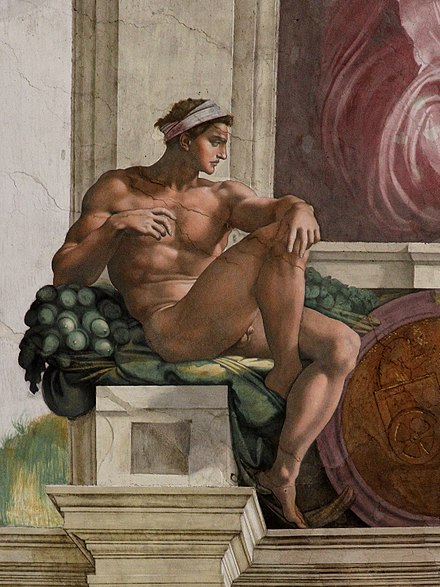
Crucial Ignudi

Creator: Michelangelo

Date Created: 1508-1512 AD

Style: Renaissance

Type: Painting

Location:  Sistine Chapel

The Crucial Ignudi are 20 figures that sit at the corners of the paintings that span the length of the center of the Sistine Chapel ceiling. The each depict a man sitting in different positions. The term Ignudi comes from the latin word nudo which means naked. These Nude figures make up the framework of the paintings on the chapel ceiling and are seen as paired. The two men sitting across from each other seem to be nearly mirroring each other but as you move across the ceiling, the figures mirror each other less and less. These pairs hold up ribbons and shields that frame the central paintings.

These characters represent Michelangelo’s image of the ideal man in this era. The men are shown as youthful, muscular and strong. They are positioned so that as your eyes move from one painting on the ceiling to the ext you will see them, not main figures, but strong supporting ones. We see the artistry and the sense of depth, as well as realistic anatomy that Michelangelo conveys here, showing not only his skill but appreciation for the body and staying true to what it looks like. By having the bodies in many positions he is able to accentuate different parts of the human body and shows the details of what the ideal man looks like. Having these figures in the Sistine Chapel, it was important that they looked perfect as this was one of the holiest places and the place where many came to worship as well as where the Pope taught. Only the best art could be here and Micheangelo portrayed man as he saw this.

Sistine Chapel ceiling. (2019, March 13). Retrieved from https://en.wikipedia.org/wiki/Sistine_Chapel_ceiling#Ignudi

Vitruvian Man

Title: Vitruvian Man

Creator: Leonardo De Vinci

Date Created: Around 1487

Style: Renaissance

Location: Galleria dell ‘Accademia

Physical Dimensions: 1’ 2” x 0’ 10”

Type: Drawing

The Vitruvian Man was created by Leonardo De Vinci around 1487. It was based on a method of beauty established by 1st century BC Roman architect and scholar Vitruvius. The method was based on calculation of proportion and symmetry in both architecture and anatomy. The man is drawn in pen and ink on paper and is accompanied by notes based on the work of Vitruvius. It depicts a man in two overlaid positions with his arms and legs apart, inside a circle and square. Leonardo also chose to draw the man with four legs and four arms, allowing him to strike 16 poses simultaneously. The man’s face is also divisible into three equal parts. All of this makes the depicted man perfectly proportional, making it an ideal representation of the male body. This is because the proportional relationship of the parts reflects a “medical” symmetry of elements, which ensures a stable structure. In fact, the Vitruvian Man shows ideal proportion so much that it is sometimes instead referred to as Canons of Proportion or Proportions of Man. Leonardo was also very interested in proportion and this image shows that. It is also shown in Vitruvius’s notes that were put below the drawing. The notes describe the perfect proportions, therefore describing the perfect and ideal body that Leonardo depicted above them.

 An example of some of the notes written are:

  • four fingers equal one palm
  • four palms equal one foot
  • six palms make one cubit
  • four cubits equal a man’s height
  • four cubits equal one pace
  • 24 palms equal one man

The Vitruvian Man is stored in the Galleria dell ‘Accademia in Venice, Italy, but is displayed only occasionally. This is because it is made of paper, so it is very fragile. Even when it is concealed, the drawing remains a key part of their collection and, ultimately, one of the most important works of the Italian Renaissance.


The Vitruvian Man – by Leonardo da Vinci (April 13, 2019) Retrieved From https://www.leonardodavinci.net/the-vitruvian-man.jsp

The Significance of Leonardo da Vinci’s Famous “Vitruvian Man” (April 13, 2019) Retrieved From https://mymodernmet.com/leonardo-da-vinci-vitruvian-man/

Zuffi, Stefano.  How to Read an Italian Renaissance Painting.  New York: Abrams, 2010.

The Fall and Expulsion From the Garden of Eden

Image result for fall and expulsion from garden of eden

Creator: Michelangelo

Date Created: 1509-1510 AD

Style: High Renaissance

Physical Dimensions: 280 x 570cm

Type: Painting

Location:  Sistine Chapel

This Painting done by Michelangelo is based off of Genesis chapter 3. The left half of the painting depicts the fall of humanity as Adam and Eve succumb to the serpents temptation and partake from the tree from which God directly told them not to. This is the original sin of mankind and the beginning of the separation from God. Unlike the Creation of Adam, we see Adam standing up versus laying out and we are able to see part of his back. Again he is portrayed as young and muscular. Due to Michelangelo being a sculptor it is likely he is using this muscularity not only to show the youthfulness of Adam, but to also create some sense of depth of the body of Adam. Adam can be seen reaching out towards the tree from which he should not, arm extended and hand positioned similarly to his hand reaching for God in Creation of Adam showing the duality of man, as he reached out to God, and that which is perfect similarly as he reaches out toward sin. We still see Adam depicted in the form of the ideal man, made in the image of God and still has a strong stature.

In the right half of the image we see an angel casting out Adam and Eve. We see the image of the ideal man tainted in this portion of the painting. While still maintaining his physique and the image of the ideal male, Adams face has changed from the youthful and peaceful to contorted and anguished. Humanity has fallen from the level of God and is being removed from paradise. This corruption of mankind has aged the face of Adam and ruined the image of what the ideal man is.

Bertoldi, S. (2011). The Vatican museums: Discover the history, the works of art, the collections. Città del Vaticano: Ed. Musei Vaticani.

Expulsion from Paradise. (n.d.). Retrieved from http://www.michelangelo.net/expulsion-from-paradise/

Hercules and the Hydra

Creator:Antonio Del Pollaiolo

Title:Hercules and the Hydra and Hercules

Date Created: Around AD 1475

Physical Dimensions: 17 x 12 cm.  

Type: Painting

Location:Uffizi Gallery in Florence

Hercules and the Hydrais part of a series of three paintings by Antonio Del Pollaiolo.  He created them around AD 1460 and finished this piece in AD 1475.  It is thought that Pollaiolo was commissioned to do the Hercules and the Hydrapiece for the Palazzo Medici by Cosimo the Elder or his son Piero.  Hercules and the Hydrais painted on tempered wood and is 17 x 12 cm.  One key aspect for recognizing Hercules is the lion’s skin and club he has with him, which often accompany him in art.  These and occasionally a bow and arrow are distinct symbols of Hercules.  The lion’s skin and club are prominent features in Pollaiolo’s work.   

The legend of Hercules is a myth of a god’s son born from an affair Jupiter had with a mortal woman, which lead to Juno, Jupiter’s wife, who was also a god, hating Hercules.  He was one of the most famous heroes in Greek mythology, and this fame also transcended into the Roman culture.  When trying to win the king of Tiryns’ daughter, Hercules completed twelve labors, which are the stimulus for his fame as a great warrior.  This warrior strength added to his popularity.  Hercules’ fame among the people of the time is one reason this piece is a good indicator of the ideal male body in art. Hercules became a model of physical strength and courage, which is one key factor in why this painting highlights the ideal male body during the early renaissance.

In this work, one can see the strength and athleticism of Hercules. His muscles are well defined in every area.  His chest and arms are very muscled, and his action helps illustrate his strength. Hercules’ action is an evident example of what it is to be a strong man in this time period.  With his arm lifted high as he clubs the Hydra, the viewer can almost feel the terrifying ferocity and strength coming from this man.  This strength is a key aspect of a warrior of this time, which is one important feature of the ideal man in this era.  He is also clearly conquering the beast he fights, which adds to the terror and awe of this work. These types of strength and athleticism are definitely important parts of the Fifteenth century’s views on the ideal male.  Another important aspect of this work is the positioning of Hercules.  He is the primary feature of the work.  His body takes up much more room than that of the monster or background.  This is yet another focal point in understanding the importance of this figure. These different aspects manifest in the painting through Hercules’ actions, placement and muscular physic, which is why it is one of the works that was chosen to highlight the ideal male body during the renaissance.    

Heracles. (2019, February 18). Retrieved from https://en.wikipedia.org/wiki/Heracles

Fossi, G. (1999). The Uffizi: The official guide, all of the works. Florence, Italy: Giunti.

Lernaean Hydra. (2019, March 06). Retrieved from https://en.wikipedia.org/wiki/Lernaean_Hydra

Impelluso, Lucia, Stefano Zuffi, and Thomas Michael. Hartmann. Gods and Heroes in Art.  Los Angeles: J. Paul Getty Museum, 2002. 

Charles at Muhlberg

Title: Charles at Muhlberg

Creator: Titian Vecellio

Date Created: 1547 A.D.

Style: Renaissance

Physical Dimensions: 132 in × 111 in

Type: Oil painting

Location: Museo National del Prado

Titian was born in the mountains of northern Venice into a humble family.  He achieved much prestige and had an unshakeable reputation.  He had good judgement and became very wealthy.  He won the some of Europe’s most powerful rulers’ friendship.  He trained in Bellini with many of his potential rivals such as Giorgione.  Titian was successful in pleasing great rulers with decorative mythologies in apartments and portrait painting. He had an instinct for a blend of flattery, idealism, and realism and this became the hallmark of aristocratic portraits.

Titian met Charles V at Bologna in 1533 when the emperor made him Count Palatine.  After the Battle of Mublberg, Charles summoned Titian to paint his portrait and several other members of the royal household. The painting was a celebration of one of the most important victories (Battle of Mublerg) against the Protestant league in 1547.  The painting shows an exquisite feel for color and rich expression of oil point. This painting is closely associated with Albrecht Durer’s print of a haggard soldier on horseback riding through the forest. The print is believed to represent human fortitude which is a characteristic Charles V should have as he struggles to preserve his empire and religion.

In the painting Titian deliberately uses no symbols or props.  Charles V rides out alone confident and richly clothed.  He looks straight ahead with a firm jaw.  In reality, Charles was suffering from asthma and gout and in his late 50s.  The emperor wears a golden fleece around his neck which is the symbol of the order of the golden fleece.  The order was composed of 24 knights who vowed to join together in defense of the catholic faith.  Charles V used the knights as a consultative assembly.  The ideal man in this time period is one who strong and a member of faith.  The use of no props may symbolize that ideal men are strong and do not need props or symbols to prove they are stronger.  It is not the props and symbols that make them strong but themselves.  Also, in the painting Charles V rides out alone which implies that he is brave and can fight what comes his way.  Charles V wears the golden fleece to make a statement that he is defending the catholic faith.  Having a person of catholic faith in power such as Charles V and painting him with the golden fleece symbol encourages Italians to also defend the Catholic faith.  The ideal man is one who is strong and a man of faith.

Cumming, Robert. Great Artists.  New York : DK Publishing, 1998.

ND 1145 C863

Emperor Charles V at Muhlberg. (2018, May 16). Retrieved April 2, 2019, from https://www.artble.com/artists/titian/paintings/emperor_charles_v_at_muhlberg

Federico Da Montefeltro

Title: Federico Da Montefeltro

Creator: Piero Della Francesca

Date Created: c. 1475

Style: Renaissance

Physical Dimensions: 47 x 33cm

Type: Oil painting

Location: Uffizi, Italy

Piero was born in a small Italian town called Borgo San Sepolcro.  His father died when he was young and later on he went to work in Florence with Domencio Veneziano. Piero remained an independent master even as he studied under many great artists.  He worked outside of Florence and received commissions for religious works and portraits in Rome, Ferrara, Rimini, and Urbino.  His art is of order, realism, and clarity.  He lived an uneventful life and then died relatively unknown.

Piero painted the most celebrated of dukes of Urbino, Federico Da Montefeltro.  The duke was a model Renaissance prince, upright, fearless, successful on the battlefield, and deeply religious. He encouraged the arts and enjoyed the company of poets and painters. Federico Da Montefeltro surrounded himself with scholars and and assembled one of Italy’s largest libraries. The tradition of learning, civility, and patronage was continued under Federico’s son and wife.

In the portrait Piero shows Federico left side so that way his damaged eye can be seen acknowledging the flat profile prose common of that time period. Federico’s eye was damaged in a jousting tournament where to please a lady friend he kept the visor of his armor open and his opponent caught him in the eye and nose.  From the painting the ideal man is not one who is good looking according to the realism of the dismantled nose, eye, and warts on the dukes face.  An ideal man is not afraid of his deformities because that is not what makes him a man but it is how he acts and his moral goodness.  Looking at the duke he was a model man in society.  He held good judgement, was strong and fearless, especially in battle, and religious. An ideal man is one who exceeds society’s standards and is morally good.

Cumming, Robert. Great Artists.  New York : DK Publishing, 1998.

ND 1145 C863

O’Doherty, E. (2013, May 15). Europeans, No 20: Federico da Montefeltro. Retrieved April 2, 2019, from https://www.irishtimes.com/culture/europeans-no-20-federico-da-montefeltro-1.1393151

Bacchus by Michelangelo Merisi de Caravaggio

Title: Bacchus

Creator: Michelangelo Merisi de Caravaggio

Date Created: 1595 A.D.

Style: Baroque/ Renaissance

Physical Detentions: 37 x 33 ½ in

Type: Oil painting

Location: Uffizi Gallery, Florence

Michelangelo Merisi de Caravaggio was known for his flawed temperant and violent behavior. Caravaggio grew up near Bergamo in northern Italy, he was left at age 17 alone in the world and with a small inheritance. He decided to go to Rome and make a name for himself.  He soon ran out of money and lived in poverty until he joined the household of Cardinal Del Monte. He began to develop an art with a dramatic realism and theatrical lighting that was completely new and exciting.  In 1606 at the height of his success he murdered a friend in a fight over a wager and then fled to Napes and died in exile at the age of 37.

In 1595 Caravaggio painted Bacchus.  This painting is an original representation of Bacchus the god of wine.  It was most likely produced while Caravaggio was working for the cardinal De Monte who was a patron of the arts and commissioned the artist to produce paintings of young men. Scholars speculate that Caravaggio may have been the model as well as the artist. He may have used a mirror or some early forms of camera lucida, a reflecting device that allows the artist to see both the painting and the canvas. In the painting, the god is dedicated to a life of physical sensuality (as was the artist) and displays a wanton expression.  Caravaggio plays with contrasts using realistic detail and theatrical posing.  He displays this contrast in this painting with the model’s muscular right arm and face and made up eyebrows and curly black wig. Bacchus holds a overfull glass of wine extending an invitation to the pleasures of the flesh but his fingernails are dirty which symbolizes that the pursuit of luxury and pleasure come at a price.   The still life detail of the painting is symbolic of overindulgence and transience of innocence.  The ideal man, according to Caravaggio, is one who enjoys the pleasures of the flesh and pursues luxury which is displayed in the painting by the theatrical posing, overfull glass of wine, and the luxurious clothes Bacchus is wearing. But even the ideal man must pay for his way of life which is hinted at by the dirty fingernails. 

Caravaggio’s use of new dramatic lighting and obsessive realism influenced the imagination of many painters.  Many young and ambitious artists came to study his work and returned home to spread the word about the style he used.  He influenced artist such as Gentileschi, Velasquez, and Rembrandt.

Cumming, Robert. Great Artists.  New York : DK Publishing, 1998.

ND 1145 C863

Bacchus by Caravaggio – Facts & History of the Painting. (2013, April 14). Retrieved from http://totallyhistory.com/bacchus/

David

Title:David

Creator:Michelangelo

Date Created:1501-1504

Style:Renaissance Statue

Physical Dimensions:517 cm x 199 cm

Type:Marble statue

Location: Galleria dell’Accademia

When Michelangelo created The Statue of David, he was only twenty-six years old, but was already one of the most successful artists of his day. His depiction of David was unique, because it was the first time David was depicted before his battle with Goliath instead of after. In Michelangelo’s statue we see David standing relaxed and alert, in a pose known as “contrapposto”. He is carrying his slingshot over his shoulder, but it is almost invisible, showing that David’s victory was of cleverness, not sheer force. David shows self-confidence and concentration. These were both considered values of a “thinking man” in the Renaissance time, which is part of what makes David a depiction of “the ideal male.” He is also a depiction of “the ideal male” because he is muscular and athletically built. This is shown in his watchful and bulky eyes, as well as pulsing veins on the back of his hands. Also with the curve to his taut torso, and the thigh muscles in his right leg are flexing. These were all aspects of an ideal male in the Renaissance time. However, Michelangelo did give David an unusually large head and an imposing right hand. Some scholars believe that these atypical proportions are because the statue was originally meant to be placed on the Cathedral of Florence roof line, and important parts of the sculpture had to be emphasized in order to be seen from below. Other scholars believe that Michelangelo intentionally over proportioned the head to highlight the concentration, and over proportioned the right hand to symbolize the considered action. When creating David, Michelangelo first created him as a wax structure. He then submerged the structure in water, turning the structure into a marble statue. It is thought that he may have gotten the inspiration for this method because he built the entire statue out in the courtyard, even when it rained, and he and the statue would get soaked. The Statue of David was originally meant to be displayed in the roof line of the Cathedral of Florence, but once it was unveiled, it was decided that the statue was too perfect to be placed up high in the cathedral. The Statue of David was placed in front of Palazzo della Signoria until 1873. In order to prevent damage and further weathering, has since been moved to Galleria dell’Accademia, where it can be seen today.

Michelangelo’s David (April 13, 2019) Retrieved from http://www.accademia.org/explore-museum/artworks/michelangelos-david/

Michelangelo and the Creation of Adam

Creator: Michelangelo

Date Created: 1512 AD

Style: Renaissance

Physical Dimensions: 279 x 569 cm

Type: Painting

Location:  Sistine Chapel

           Michelangelo was born March 6, 1475 in Florence Italy and became a well-known Renaissance artist. He is best known for his work painting the ceiling of the Sistine Chapel in the Vatican. His work encompassed paintings, sculptures, as well as some design. Most of his life he spent working in marble sculpting, but he practiced many forms of art throughout his life as was fairly customary during the time period. Michelangelo was one of the most documented artists of his time, and even had biographies published while he was alive. He began his apprenticeship as an artist at 13 years of age but ended his apprenticeship after a single year. He was taken in among scholars and poets as a select group by Lorenzo the Magnificent. After his time working in the group, he moved to Bologna to continue his career and helped complete the tomb and shrine of Saint Dominic.

           His career continued forward and he eventually went on to paint the ceiling of the Sistine Chapel in the Vatican which is one of the things he is best known for. One important section of the ceiling was the Creation of Adam. The Creation of Adam was a very important piece not only for the chapel, but for the study of the ideal male body, as Adam was the first man created in the likeness of God. The art was seen as divine in a way, as it depicted not only Adam but also God, the one who created all. Because Adam was the first person ever created in the image of God, he truly is a depiction of the most ideal male body. Adam is shown laying out, showing his nude body fully representing Michelangelo’s ideal of the ideal man. Adam is portrayed as a muscular young man reaching out to God. This sense of youthful ness and muscularity places emphasis on the importance of health and well being as well as strength in the male body. God is shown as an older man, symbolizing wisdom, reaching out to his creation, fingers outstretched ready to connect to Adam, a connection that only one man has experienced in such a way. This shows the value that is in man because of God. The connection that man has to God is unique amongst all other creation as man is the only one created in the image of god and that God breathed his breath into. The blue ribbon hanging down from God symbolizes the peace and tranquility of the moment and the connection between God and Adam as life was passed into man. Not only is his physical appearance an ideal, but his proximity to God is as well, for Adam personally walked with God and was able to experience his glory.

Bertoldi, S. (2011). The Vatican museums: Discover the history, the works of art, the collections. Città del Vaticano: Ed. Musei Vaticani.

Gilbert, C. E. (2019, March 02). Michelangelo. Retrieved from https://www.britannica.com/biography/Michelangelo

The Ideal Male Body In Italian Art

Introduction

The ideal man in Italian culture has varied throughout the ages.  One area that this idealism can be clearly seen is in the artwork of Italy. Art is something that transpires in every time and most cultures, yet it is not always a staple.  For Italian society, art is one facet of the culture that often shows the time period’s societal norms and ideals.  The standards for the body are no exception.  In today’s culture the art of movies and media images give examples of body idealism.  Movie stars, models, and sports figures present the standard for a culturally perfect body.  In Italian culture, this is no different. Their art can highlight the perfect image of the male body. Art often provides a snapshot of the ideals and standards of an era.  Throughout this blog representative works of art will be analyzed to evaluate the ideal male body in Italy’s culture during the late fifteenth and sixteenth centuries.

            One of these pieces is Antonio del Pollaiuolo’s painting of Hercules and the Hydra. Pollaiuolo does a wonderful job of presenting the male body with its powerful and idealistic stature. Hercules’ reputation was well known at the time, and so this informs the painting.  This reputation explains why this work exemplifies the era’s idealistic male form.  This is a useful piece to discover both the esthetic and internal ideals that the Italians held for the male body.  

Leonardo Da Vinci is another of the early artists evaluated in this project.  The Vitruvian Mangives a detailed diagram of an Italian man.  His work of art set a precedent for what the ideal male looked like.  This work of art shows the ideal proportions of the male body, according to Da Vinci.  This is truly a rendering of what an ideal body looked like for the time.  Created around 1490 AD this is one of the older pieces that will illustrate the ideal male body during the time.   

            Michelangelo is a very well known Italian artist, so it is only natural to incorporate his works into the study of the time.  His statue of David is one of his best-known works of art, which also happens to highlight the perfect male body in the culture.  Because David was such an important religious figure, it is natural to give him the ideal stature.  Michelangelo created this statue between AD 1501 and 1504 , and even today it is well known as one of the great Renaissance masterpieces.   

Another of Michelangelo’s famous works is the Sistine Chapel ceiling, which has many parts.  It is one of the largest paintings by Michelangelo and can be examined as many different works put together.  For this project we will divide this masterpiece into three sections to evaluate the ideal male body.  The first part is the Creation of Adam.  Similar to David, this section of the Sistine Chapel’s ceiling shows a revered biblical figure.  The body features, facial expression, and body positioning, all illustrate an Italian view of the ideal male body.  The Crucial Ignudi gives several ideal male figures that are encircling another scene.  Their significance and participation in many areas of Michelangelo’s work on the Sistine Chapel further illustrate the idealistic male body of the time.  The Fall and Expulsion of Manfrom the Garden of Eden is yet another scene where Michelangelo enables the viewer to see the idealistic view of a man.  Even in sin, Michelangelo paints Adam as perfect.  This section of the work has further presented the ideal human body of his time. Michelangelo provides a model piece for comparing and contrasting the artistic beauty of man in varying settings and for various purposes.   

            Lucas Cranach’s portrait of Adam also illustrates the beauty and idealism of the male body.  This work gives interesting contrasts and comparisons to the earlier work of Michelangelo.  The common traits of the ideal body are presented, with some further additions to the study of Italian culture’s ideal male body type.  This piece will help to illustrate the commonalities across different creators, since there are other portraits of Adam being analyzed in this blog. 

            The Italian Renaissance artist Titian’s painting entitled Equestrian Portrait of Charles V is another illustration of the ideal male form in the sixteenth century. This painting is rather unlike some of the others because it promotes a fully clothed image of Charles V. He sits on a horse in his armor, presumably ready for battle.  This gives insight into a different type of idealism, but also remains true to some of the common themes that are seen in this time period’s artistic renderings of men. This portrait enables the study to focus on some of the more hidden aspects of the Italian artists’ creations of idealistic art.  

            The Italian artist Michelangelo Merisi Da Caravaggio’s painting of Bacchus, a Roman god, also highlights another aspect of the Italian idealism.  This painting shows the wealthy and plump version of a god.  The contrasts here to many of the other paintings of the time are striking, but also interesting due to the differences of this idealistic god-like body versus that of the more idealistic human body.  

            Through a more detailed look at each of these works of Italian art, the ideal male body, as seen during the late fifteenth and throughout the sixteenth century, will be analyzed.  These idealistic renderings of the Italian male body help the twenty-first century understand better the idea of the perfect body’s of Renaissance Italy.  From Pollaiuolo to Caravaggio, the years show the contrasts and similarities of the ideal Italian male body.  

Resources

Adam and Eve (Cranach). (2018, May 19). Retrieved from https://en.wikipedia.org/wiki/Adam_and_Eve_(Cranach)

Antonio del Pollaiolo. (2019, February 05). Retrieved from https://en.wikipedia.org/wiki/Antonio_del_Pollaiolo

Bacchus (Caravaggio). (2019, February 16). Retrieved from https://en.wikipedia.org/wiki/Bacchus_(Caravaggio)

Cumming, Robert. Great Artists. New York : DK Publishing, 1998.

ND 1145 C863

Cumming, Robert. Annotated Art.  New York: Dorling Kindersley, 1995.

ND 1145 C86 

David (Michelangelo). (2019, March 16). Retrieved from https://en.wikipedia.org/wiki/David_(Michelangelo)

Equestrian Portrait of Charles V. (2018, December 23). Retrieved from https://en.wikipedia.org/wiki/Equestrian_Portrait_of_Charles_V

Fossi, G. (1999). Tbhe Uffizi: The official guide, all of the works. Florence, Italy: Giunti.

Kren, E., Marks, D., & Web Gallery of ART. (n.d.). Hercules and the Hydra. Retrieved from https://www.wga.hu/html_m/p/pollaiol/antonio/painting/hydra.html

Michelangelo. (2019, February 16). Retrieved from https://en.wikipedia.org/wiki/Michelangelo

Sistine Chapel Ceiling. (n.d.). Retrieved from https://www.google.com/search?client=safari&rls=en&q=sistine chapel ceiling&ie=UTF-8&oe=UTF-8

Vitruvian Man. (2019, March 16). Retrieved from https://en.wikipedia.org/wiki/Vitruvian_Man